The Perfect Format for Asides (an aside)
For a long time now, but especially since I started using this blog, I've been very concerned with the correct way to include tangents and asides in my text. I'm a chronic rambler, and being able to consign the particularly unrelated parts of what I'm writing to a purely optional area of the page is very important to continue pretending like I can maintain some kind of flow. It's your fault that you clicked on it and broke your train of thought, not mine!
Originally it never occurred to me that there might be some native markdown for it, so I was using full html tags to link within the page,1 because it's what I was used to. I only recently learned about the [^1] syntax for footnotes, and installed a plugin to make it even easier. Bliss, surely.
But in truth, that's not what I want. Footnotes are great for three situations - complete non-sequiters, to recommend further reading, and when you're dealing with printed media.
In a single long page, a footnote linked in paragraph one just feels so separated from the text, and I can't fully articulate the ick it gives me to have more than one of them.
One solution I've seen, often alongside the bottom-of-page-footnotes, is to have a little pop-over frame that contains the text. Wikipedia makes a ton of use of this format for all internal links and footnotes, and it's great for very short asides or references, but for full-scale tangential ramblings I feel like it doesn't quite hit the mark.
I've been looking for a while, without the language to properly search, for an inline footnote system. Here's the idea.
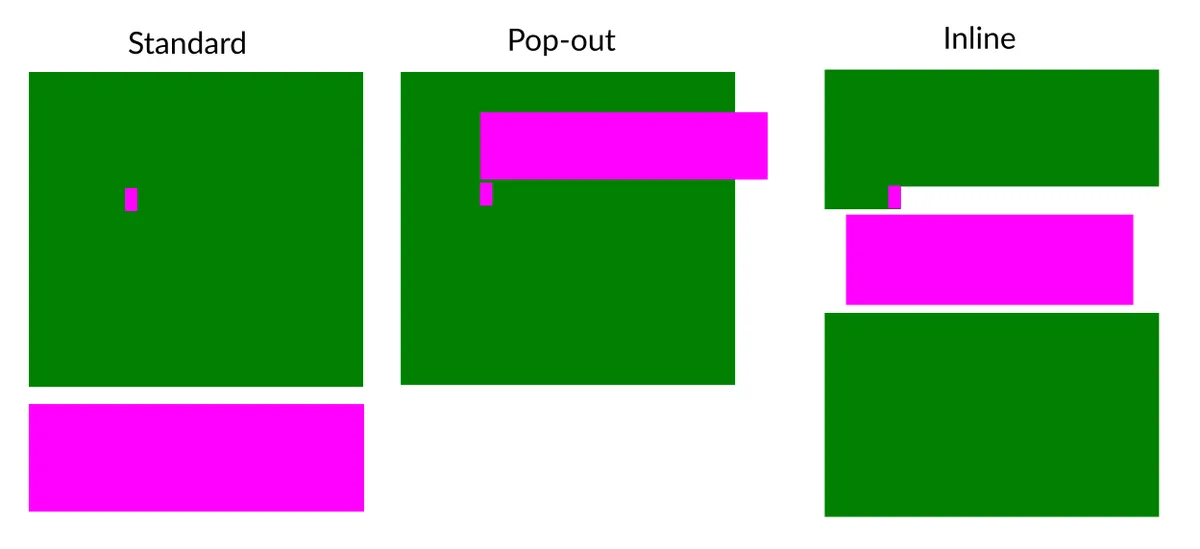
Reading green as the main text, and the snazzy magenta as the footnote and link.
What I want is to click on the footnote [^1] link and have the note carve as pace for itself within the text. This is not only just a superior way to read it, fully typeset within the page, it also perfectly represents my inability to structure a thought.
The main issue I can see with this in a markdown context is that markdown is very... literal. Best I can tell, you can't really display text out-of-order relative to how it is in the .md, so my footnot would have to legitimately live within the space created in the paragraph - this indicates to me that it might require some kind of special parenthesis format - a set of brackets that the processor compresses to a simple [^1] by default, but unhides or rearranges the text when clicked, undoing itself on a reclick.
A rough example in raw .md might look like:
When I talk about input latency [==honestly, when am I not talking about input latency==], it's important to recognise that...
Which would open up as something like:
When I talk about input latency
honestly, when am I not talking about input latency
it's important to recognise that...
I'm way too blunt in the ways of CSS and html to make such a thing work, but maybe you're reading this and thinking you could do it. Please let me know if you think this is doable. I cannot overstate how good this would be for my mental health before I forgot it was possible and went back to html tags for some reason.
Months of this. Over a year. (Note - I have since fixed this! Look at how beautifully inline this is! Formatting could still do with some work though.)↩