Some Sumo Trivia Stats
I've been tinkering with data sources for doing Sumo analysis, from two main sources (well, one really):
- SumoDB - Specifically the Yusho page for a quick overview of winning performances.
- A database created by Ryan McCorvie from SumoDB for a Sumo Elo ranking, and while it has a bunch of features that are bad for general use (it's very focused on the Elo goal, it doesn't include playoff matches, it's very clearly heavily vibecoded) it does get me from step 0 (no data) to step 2 (stats and shit) really quickly. I'll probably rebuild this to suit my own purposes later, but I'd already hammered the SumoDB API heavily enough with this first go, and playoff results aren't that important for most things.1
In the end, I found a few fun little tidbits in the historic record, and want to keep looking for more. You may have heard about some of this stuff before, but I hadn't.
The Single Injured Yusho Winner
In sumo a Yusho is a tournament win - divided by division, but generally without qualifiers a "Yusho winner" is the top division winner.
From the SumoDB Yusho page, I made a spreadsheet to investigate so called Zensho Yusho - 15-0 perfect records. But in cleaning it up, I ran into a weird outlier.
In November 1973, Yokozuna Wajima won his 4th Yusho with a 12-2-1 record. The 12-2 are his wins and losses, but the last "1" has a slightly different meaning: those are days he missed after going kyujo - pulling out of the tournament.
The story for this is found on Wikipedia:
...in November 1973 he became the first wrestler ever to withdraw from a tournament while still managing to win it. He had split the webbing between his fingers in his Day 12 win over Takanohana, and lost the next day with his hand bandaged. As his only challengers on Day 13 had a fourth loss, he was able to sit out the last two days and still win the championship with a 12–2–1 record.

He remains the only Yusho Winner of the modern era (basically 1958 onwards, when there are 6 basho per year) to do so with a kyujo loss. He's not the only one to do so while injured - because bouts are scheduled a day in advance if a rikishi is injured and pulls out the following day they have a "fusen" loss, which is marked down as a regular loss so their opponent gets a win. The kyujo field is specifically for days they had no scheduled opponent.
Notably, Chiyonofuji won the March 1989 Basho 14-1 after a fusen loss to future Yokozuna Asahifuji on the final day - he had recurring shoulder injuries and dislocated his left shoulder defeating Onokuni.
Low Win Yusho
It's no conspiracy to say that we're in a "low wins" era of sorts. The last 5 basho have been won with 12 wins, with only 4 of the last 30 (since Hakuho's retirement after the July 2021 basho) with scores of 14+ wins. After 15 years of Hakuho, are we just "back to normal" or is this an outlier in the broader history of the sport?
The chart below makes the case that this is a significant outlier era.
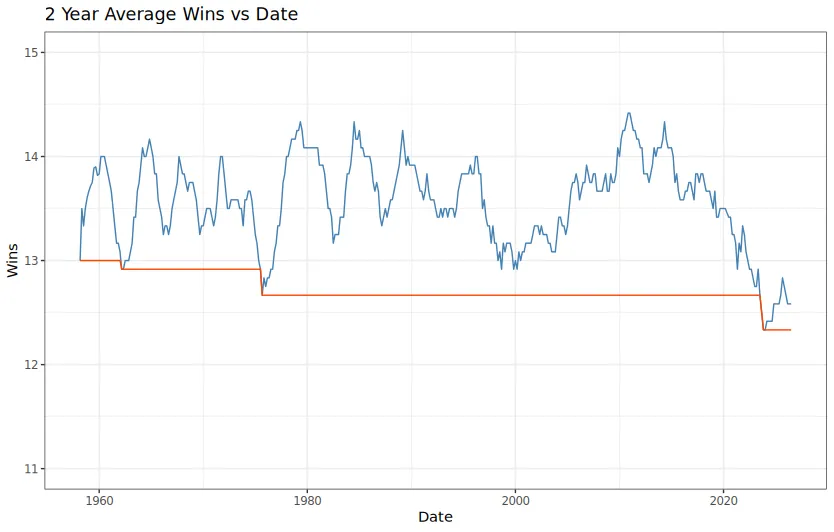
This shows the winning record for yusho as a 2-year (12-basho) rolling average. Marked in red is the at-that-time historic lowest average. What's cool about this chart is that you can see certain periods of... not necessarily dominance, but of dominant wins - Taiho and his rivals throughout the 60s, the Kitanoumi-Wajima-WakanohanaII complex from 1975-1980, then a lull before Chiyonofuji fully got rolling with his high records, and the wildly powerful wrecking era of Asashoryu-Hakuho from 2003 onwards.
You also see the massive falloff in average when Hakuho retired - there was a small delay before Terunofuji's injuries caused him to fall back and leave the sport functionally Yokozuna-less for much of the following few years.
One thing this does highlight is the possibility that "low wins" doesn't mean "bad yusho" - the late 90s early 00s era was very exciting, including the likes of Takanohana, Wakanohana III, Musashimaru, Kaio, and Akebono getting yusho with lower-than-typical average wins. but not to the extent of today - barring the small peak in September 2025 (when Onosato and Kotoshoho had 3 consecutive 13+ win yusho), any 12-basho sample since 2023 (i.e. including basho back to 2021) would be considered a historic low average.
Zensho Yusho
The actual trivia I was looking into was around perfect 15-0 Zensho Yusho. Some of the great rikishi are known for them: Kitanoumi and Chiyonofuji had 7 apiece, Taiho had 8, and Hakuho had 16 - including 4 consecutive basho in his 63-bout winning streak in 2010. Futabayama also had 8 zensho in the pre-modern era but several of those were less than 15-day basho and there were fewer basho per year.
The real question I was interested in was about zensho droughts - how many tournaments passed between sequential zensho, and was it indicative of the strength of field in Grand Sumo at the time?
Zensho are extremely difficult to achieve, and so relatively rare. Of the 410 Basho since January 1958 there have been 69 Zensho - that's 16.8%, or almost exactly 1/6 tournaments. So you might expect one once per year.
But as I've said before, they tend to be associated with particularly strong Yokozuna - the 4 men mentioned previously account for 38 of the 69 zensho in the last 68 years, so they're clustered around their peaks. We see gaps, we see droughts, and sometimes they last a while.
Currently, it has been 28 yusho, or 4 years 8 months, since Terunofuji got the most recent Zensho in November 2021. We came close in May last year, when Onosato went 14-0 before being toppled by Hoshoryu on the final day, but apart from that we haven't really seen a strong threat of one.
How does this compare to historic droughts?
Well, the second modern-era Zensho was by Wakanohana I in March 1960, and was followed by an 18-bout drought before Taiho broke it with his first Zensho in May 1963. A 21 basho drought was broken in March 1977 by Kitanoumi with his first, then there was a fairly steady supply of Zensho until Chiyonofuji's final Zensho in September 1989 which was followed by a 28 basho gap before Musashimaru's maiden Yusho in July 1994 - the same length of drought we're currently seeing.
We then saw a handful of Zensho by Takanohana over the next few years until his last in September 1996 - this was followed by a 6-year drought ended by Asashoryu in January 2004, a 43-basho gap! This is by far the longest drought, and it corresponds to the generally "low wins" period we observed around the turn of the millenium previously.
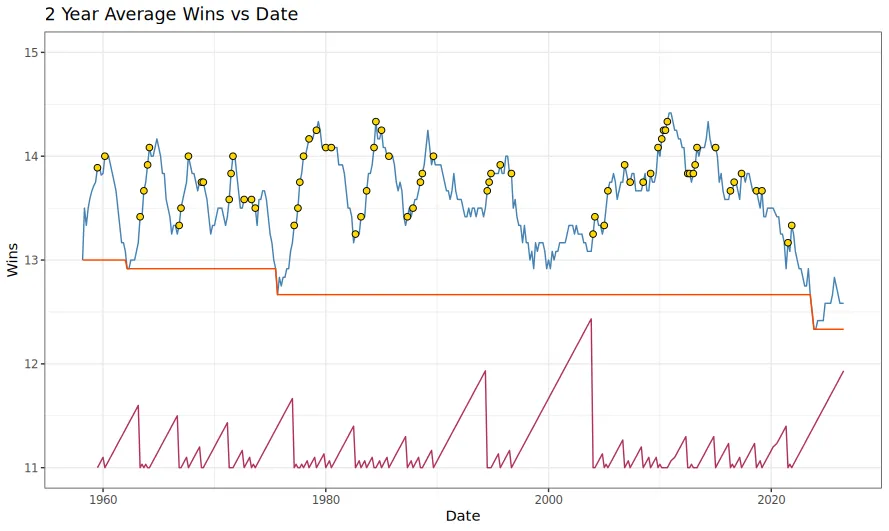 The spiky maroon line at the bottom just represents the length of the drought at a given basho
We're currently nowhere near this degree of drought, and if someone like Onosato or Aonishiki can get up to full health while their rivals are vulnerable, I think it's likely they could break this one before we're in "new record" territory.
A Quick Word on Quality
All the sumo I've ever watched live has been during this fallow period for high-scoring records. 2 years in, I don't think my enjoyment is worse-off for lacking the kind of dominant yokozuna that Hakuho represented, and the quality of competition feels as good as any historic examples I've seen described by older fans.
To give some key examples -
- The most recent July 2026 Basho was thrilling to the end - I defy anyone to say otherwise even with another 12-3 win by Aonishiki. A final day win by Atamifuji to force the 3-way playoff was pure cinema.
- The previous 12-3 win by Wakatakakage was a delight as well, though less dramatic.
- Onosato's May 2025 14-1 stomping of the field, with the last second denial by Hoshoryu was exactly what you want to see in a yokozuna rivalry.
- Hoshoryu's 12-3 playoff win was great fun to witness live, a great demonstration of his skill and strength after early mistakes.
Just so I don't give the impression that I'm down on this era. I'm loving sumo right now.
Basho Clinching
This is a little complicated.
A basho lasts 15 days, and every bout gets a binary win-lose result for each wrestler. At the end of 15 days, the wrestler with the most wins gets the yusho. Ties are broken by a playoff, but we're not looking at that for now.
To illustrate the next part, an example - it's day 14 and Rikishi A has 14 wins 0 losses. His nearest rival Rikishi B has 12 wins and 2 losses. Rikishi A cannot be caught, as there is only 1 day left in the tournament - even if A loses and B wins, he will win 14 to 13. We would say that in this case, Rikishi A has "clinched" the yusho on day 14.
Another example, Day 13 - Rikishi C has 13 wins 0 losses, Rikishi D is nearest behind with 11 wins 2 losses. If C loses his next two and D wins both of his, they will be tied on 13 wins - the yusho has not been clinched, but will be if C wins any of his remaining matches.
The simple formula for whether a yusho has been clinched is:
Where A is the leading rikishi, and B is 2nd place. If there's a tie at the top, the left hand side is 0. A 3-win lead is enough to clinch on day 13 with 2 days left. To clinch on day 12 one would need a 4-win lead.
What is the earliest a yusho has been clinched?
First, lets ask the extreme - what is the earliest a yusho could be clinched?
The Minimal Clinch
I'll start with the answer - Day 11. If someone managed to go 11-0 with his nearest rival on 6-5 or worse, that would clinch the yusho. It goes without saying, but this would be a catastrophic collapse by everyone involved, and is very unlikely to happen.
Why could a day 10 clinch not happen? It would require a 10-0 leader with everyone else on 4-6 or worse - which is impossible given that the vast majority of top division matches occur within the division - this would require the other 41 wrestlers in makuuchi to have a total of at most 164 wins against at least 246 losses - mathematically impossible.
So 10 is impossible, and 11 is outlandish - what about Day 12? There are three possibilities for a Day 12 clinch, either 12-0 vs a max of 8-4, 11-1 vs a max of 7-5, or 10-2 vs a max of 6-6. The latter two still feel very unlikely, but have we ever seen anything approaching the first 12-0 case?
There have been 6 times a rikishi has been on 11-0 with the nearest chasing rivals on 8 wins.
| Basho | Day | Rikishi | Rank | Wins | Second Wins |
|---|---|---|---|---|---|
| 197501 | 11 | Kitanoumi | Yokozuna 1 East | 11 | 8 |
| 198207 | 11 | Chiyonofuji | Yokozuna 1 East | 11 | 8 |
| 198909 | 11 | Chiyonofuji | Yokozuna 1 West | 11 | 8 |
| 199001 | 11 | Chiyonofuji | Yokozuna 1 East | 11 | 8 |
| 200501 | 11 | Asashoryu | Yokozuna 1 East | 11 | 8 |
| 200807 | 11 | Hakuho | Yokozuna 1 West | 11 | 8 |
Literally all Yokozuna, goddamn.
I will spoil early that all 6 of these leaders won the yusho, but to clinch on Day 12 they would need to win their Day 12 match while all 2nd place rivals lose theirs.
The first point is simple enough, the second is the tricky one. Typically, with a chasing score of 8-3 there are multiple wrestlers, and if any two of those rikishi face each other there is guaranteed to be a win among them. This was the case in 3 of the above basho (1975-01, 1989-09, 1990-01). In the case of Chiyonofuji in 1982, he was unable to win his Day 12 bout.
In the other two cases a Day 12 clinch was technically possible, but it required in both cases 4 chasing rikishi to lose their Day 12 match, at the best of times like flipping 4 coins and getting all 4 heads, nevermind when they are the next-best performing members of the division. Alas, none of these resulted in a clean sweep of rival losses and a Day 12 clinch.
Day 13 Clinches
There have been 21 basho decided on the 13th day. I won't bore you with a ton of detail - I'm sure there are some great stories in here, but as I've sort of alluded before I'm actually more personally invested in close fights, and 21 is a few too many historic deep dives for me to get into for a blog post right now. 2
Worth noting that this is less than 1/3 the number of zensho - this is a significantly rarer achievement, as it requires not just excellence on the winner's part, but also a failure of their competition.
Here are all the times it has happened:
| Rikishi | Count | Basho |
|---|---|---|
| Hakuho | 6 | 200807, 201005, 201111, 201303, 201307, 201501 |
| Chiyonofuji | 4 | 198501, 198505, 198909, 199001 |
| Kitanofuji | 2 | 196911, 197111 |
| Wajima | 2 | 197309, 197311 |
| Asashoryu | 2 | 200211, 200501 |
| Wakanohana | 1 | 195809 |
| Taiho | 1 | 196709 |
| Kitanoumi | 1 | 198405 |
| Wakashimazu | 1 | 198407 |
| Kotofuji | 1 | 199107 |
| Takanohana | 1 | 199609 |
| Akebono | 1 | 200007 |
| Baruto | 1 | 201201 |
| Onosato | 1 | 202505 |
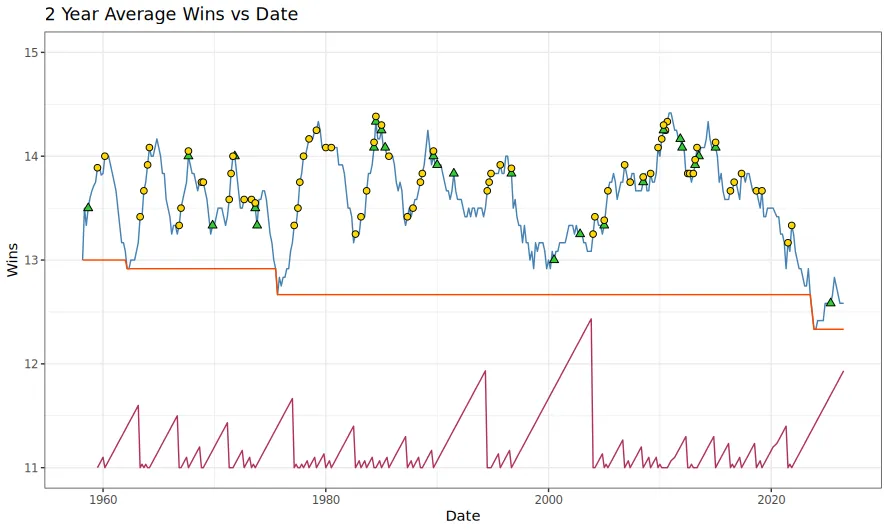
No surprises who makes up the bulk of the list, it's mostly the same guys responsible for all the zensho. An interesting couple of exceptions for me are Taiho and Kitanoumi with only one each despite their 15 collective Zensho, but that probably speaks to how competitive their eras actually were - even if they were able to beat everyone, their closest rivals were generally able to beat everyone but Taiho and Kitanoumi.
The most recent such Day 13 clinch was by Onosato in May 2025, which I've discussed above. Makes sense, it's the huge outlier in the recent history of mostly non-dominant yusho.
Conclusion
Not much to conclude here really - it's trivia!
I'm hoping to do a bit more of this sort of thing - ask questions that don't matter and see if they tell us something about the sport in a way that tallies with more "relevant" statistics.
First I'll need a better data source though - I don't love the structure of the Elo data I grabbed, I don't love the vibecodey-ness of it, and it's not built for the kind of analysis I want to do, so that's the next priority.
Thanks for reading! Buh-bye now!
For reasons I can't quite figure out, this dataset includes some missing bouts - the only meaningful one for this analysis is day 5 of the November 1978 tournament - this was a Wakanohana Zensho and gets lost from the data, but the overall shape of the charts is still correct. I could try and fudge in a fix so every chart is perfect, but I'd rather fix the data properly when I have time.↩
I'd love to dig into 1991 July particularly - Kotofuji was the only rikishi ranked below Ozeki to achieve this and did so at Maegashira 13 East.↩